
Jim is a graduate student at the Museum School of Fine Arts in the printing department. I don’t quite understand how he came to be part of the CPP but he is decidedly one of ours. He is a print nerd, much like myself, capable of geeking out for several hours over the finer details and manifold possibilities of printing. He is strange though in that he has chosen to dedicate himself to a field of printing which is almost contrary to the very nature of a printer’s obsession.
Printing, to me, has always been fascinating because it is a way to turn one idea into a lot of things which can be widely distributed for much cheaper than a solitary piece of art. Call it the socialist in me. I just want everyone to be able to have one. I was raised on comic books. I sharpened my eyes on the CYMK dot patterns. I see the world in print and plates. But monotype isn’t made for that kind of production. Each print is unique. There is no plate. A monoprint is essentially an ink painting transfer.
You start with a Plexiglas plate and whichever palette of oil based printing ink you prefer. I strongly suggest that you clear for yourself a very large space.
We started with red, yellow, blue and black. Pretty classic. Margie and Jim started smearing the colors together so that they could create a wash to fall in behind an image of two helicopters that were printed on linen paper.
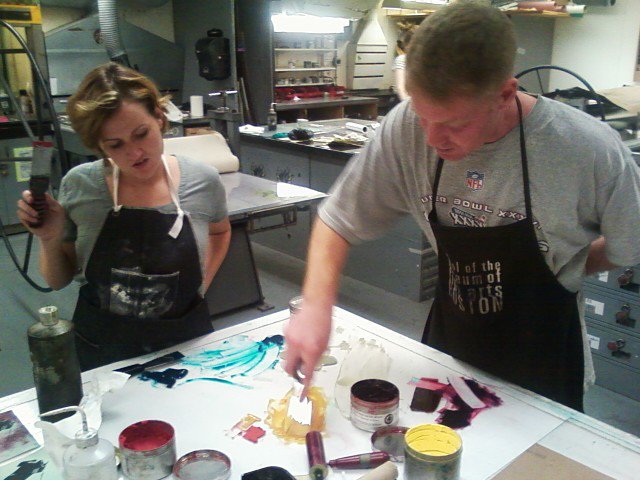
Jim and Margie get the party started...
Drew and I put together a pile of money and started xeroxing it. Jim had told us that we could do xerox transfers. I didn’t understand how this would work but it was fun to use the copy machine.
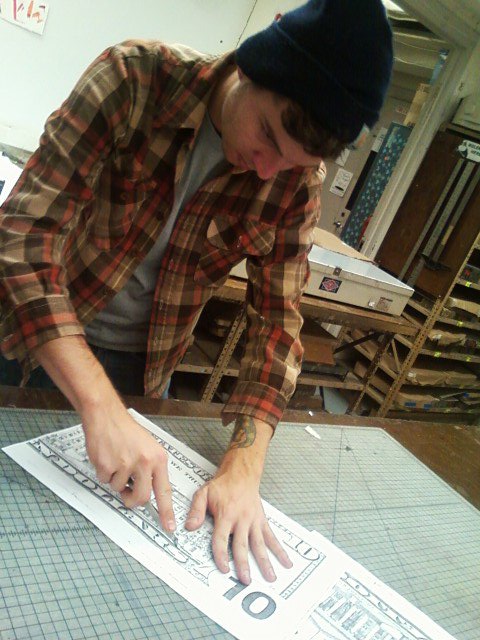
When I finished the cut out copies that I wanted I went back to the gang. They were laying the ink out on the Plexiglass plates with rollers, just kind of slopping it on. Then They were washing away the ink from the places where the helicopters would be, using that space to introduce new colors.

"and then they came for me."
Each time they did this they would get two prints. One print with too much ink, then a second more desirable print which left only a ghost of the ink. I had been pacing around trying to find something to do before I realized that I just needed to get my hands in on this project.
I quickly realized that the mineral spirits opened a whole new world into splashes and strange drippy effects that would be nearly impossible to produce in any other way. Each drop made a pool which pushed the ink to the outside of that pool, then it dried leaving a residual hue in the inside so that it appeared to be a crater. I really enjoyed playing with flicking the mineral spirits and ink onto the plane of glass. I admired Jim’s idea of using aluminum foil to create a scratchy surface. I tried to render the same thing myself but found that I had used too much mineral spirits.
The next step is to load the Plexiglass into an etching press, load your paper onto the image, then roll it through the machine to press the ink into the paper.
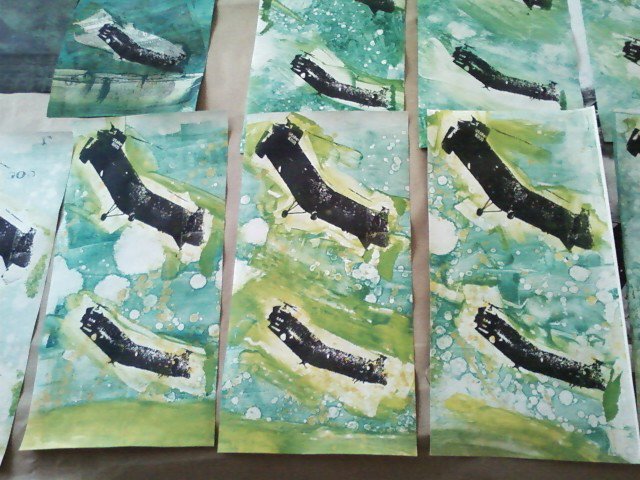
Mineral spirits make the difference...
The end result is a one of a kind image that is perfect for backgrounds. Monoprints are easy to produce with about a ten minute turn over (though you could spend more time) to create a unique texture through all of the areas in a paper not occupied by image. Because it is translucent it doesn’t hide the value of the paper itself which is often a problem with Combat Paper. You don’t want to use too much of the space, but you don’t want to leave your canvas empty either. As it turns out this process leads to a perfect solution to an age old problem for me. I am very excited to continue to implement it in my work.
It was sad that the xerox transfers never happened because I would have liked to have wrapped my head around that process. Jim produced a few of them but the paper had been wet for too long and gone through too much so it started to fall apart. Luckily I will have the resources to screen print the rest of the designs on the top.
This was my first full day on tour and I left pretty pleased that I had ink stains on my hand already. This is a good sign.
 The Paper Trail